
To reach the narrow leaves of the helichrysum you have to bend down onto your knees, there is no other way. Up here on the hill I have to move over to the sunlit shoulder of the slope to find healthy bushes growing wild on their own. But you have to bend, and Cosimo had to do the same. And he did it gladly, even though the earth, as people say around here, lies low.
Every time the theater of his life gave him a moment’s respite he went back to the garden, where rubbing the leaves of the helichrysum is enough to put your head already on the shore of the Sea. And from there, on the farther side: Sicily, Greece, Constantinople. Somehow all that world manages to break through the backwash and force its way into the valleys of Tuscany, making it all the way to Florence, so that you can almost smell that briny air, that harbor fish-stink. It does not go much farther, though: the damp beeches of the Apennines behind us already speak of another world.
And even though Cosimo went to Mass every day, even though he dined with the Pope, even though he gave churches and convents to the Dominicans, in his garden he was looking for that sea.
You could tell at once. It was nothing like stepping into one of the geometric cloisters you might find at San Marco or San Lorenzo, or among those priggish friars at Santa Maria Novella.
Here, instead, life unspooled without direction: the dark holm oaks crowded with birds, the cypresses rounded by a potter’s hand, the sharp screens of bay laurel, the soft myrtles and the deeply fragrant orange trees, which had arrived in Cosimo’s garden like some exotic devilry. An epidemic of sap packed into a few steps. And then a thousand different herbs. He had planted the helichrysum among the roses. So many roses. Too many roses, honestly, Cosimo.
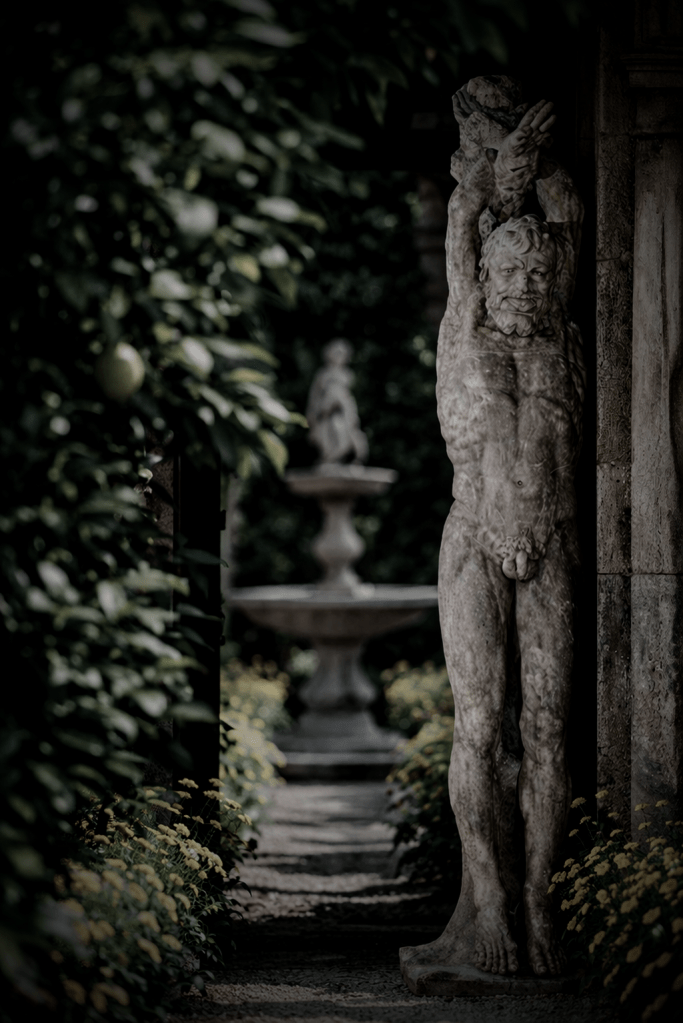
Plants were Cosimo’s passion, stones that of his friend Donatello, who would start at the mere sight of a corner of the garden spacious enough to hold the base of a sculpture. Cosimo bought them for him, of course.
Within a few years, the garden had more statues than plants. And bloody hell was it beautiful.
Donato had had a round fountain made, unlike anything anyone had seen before, all decorated with waves and strigils, as though it had come out of the workshop of some artist of ancient Rome. Cosimo finally had cool water in his garden. Water that runs not to water the roses, but to wash the thoughts clean.
When two wooden crates arrived at Palazzo Medici one evening, someone thought a funeral was being prepared. The crates, instead, contained two bodies about to be brought back to life. They were two large marble statues without heads, shoulders, and part of an arm.
Donato could barely contain himself, while Cosimo scratched his head.
After a few weeks every missing piece had been shaped, carved, and put back where it belonged with cement and a few iron dowels. But more than anything else it was that face that both troubled and fascinated the master of the house. The wrinkled face of an old man twisted onto the body of a young athlete hanging from a tree trunk, the mouth pulled tight like the girth under a horse’s saddle and running toward the pointed ears of an ancient satyr, revealing an endless row of gnashing teeth. It was an incomprehensible grin, but a grin of pain.
Marsyas hangs from the branch of the tree while Apollo, with his sharpened knife, slowly flays him. Splashes of living blood run down the cheeks of the radiant god of Poetry while the satyr writhes. A continuous tolling, the same note repeated to exhaustion. The skin opens in the sunlight filtering through the laurel leaves, making tendons and muscles glitter like a shoal of sardines beneath the skin of a dark, dense sea.
Little Lorenzo stared at that grin while the statues were being lifted from the crates to look out upon the world again. “They look like two Jesuses.” Cosimo smiled as he would have smiled before the meanest of clients. He looked at the two Marsyases raised upon the garden’s green prow while the words of his seven-year-old grandson rang in his ears. “They look like two Jesuses.”
The square of sky ringed by the loggia was crossed now and then by a white clot of sea-foam that disappeared at the opposite corner. April clouds. The sky entered the courtyard with its cold light, as though it meant to solidify once and for all that magma of bronze skin at the center of the palace court. A naked boy brandished a sword bigger than himself while seeming to trip over the head of the giant he had taken it from.
Inside, David’s bluish thighs stood out against that white sheet of limewash between the pietra serena columns. Outside, the dark branches of the holm oaks and the rosemary leaves let the chalky torso of Priapus emerge, marble lichen on bark beyond the arch, at the center of the garden. The Hebrew shepherd boy’s sword challenged the dangling member of the god of kitchen gardens and new brides.
A high wall divided the garden from the street, another from the library. The intelligence Cosimo found in the room of books had a smell of its own out here. Beyond the wall, a priest stumbled, while the bells of San Lorenzo were the only thing that could penetrate the garden.
What do you see, Donato? Donato took off his hat to beat away the dust. Life.
Pine resin streamed like honey toward roots covered with tiny violets sprung up on their own, and some insect still without a name would get trapped there. Tiny droplets of condensation. Coagulated sap.
The beast’s breath fogged the polished mirror of order.
Cosimo had been dead a long time when his descendants were driven out. The statues were carried away, the holm oaks cut down, the violets torn up, the helichrysum left to dry out. Too much life all at once: a sudden coupling, on ground inadvertently made too fertile. No one had sought it. It simply happened.
The marble of Marsyas seemed to have drawn in space the trajectory of a bird’s flight escaped from its cage, caught in the spontaneous opening of its wings.
 geniuslooci
Lascia un commento